
How to take Cornell notes
Updated
The short answer
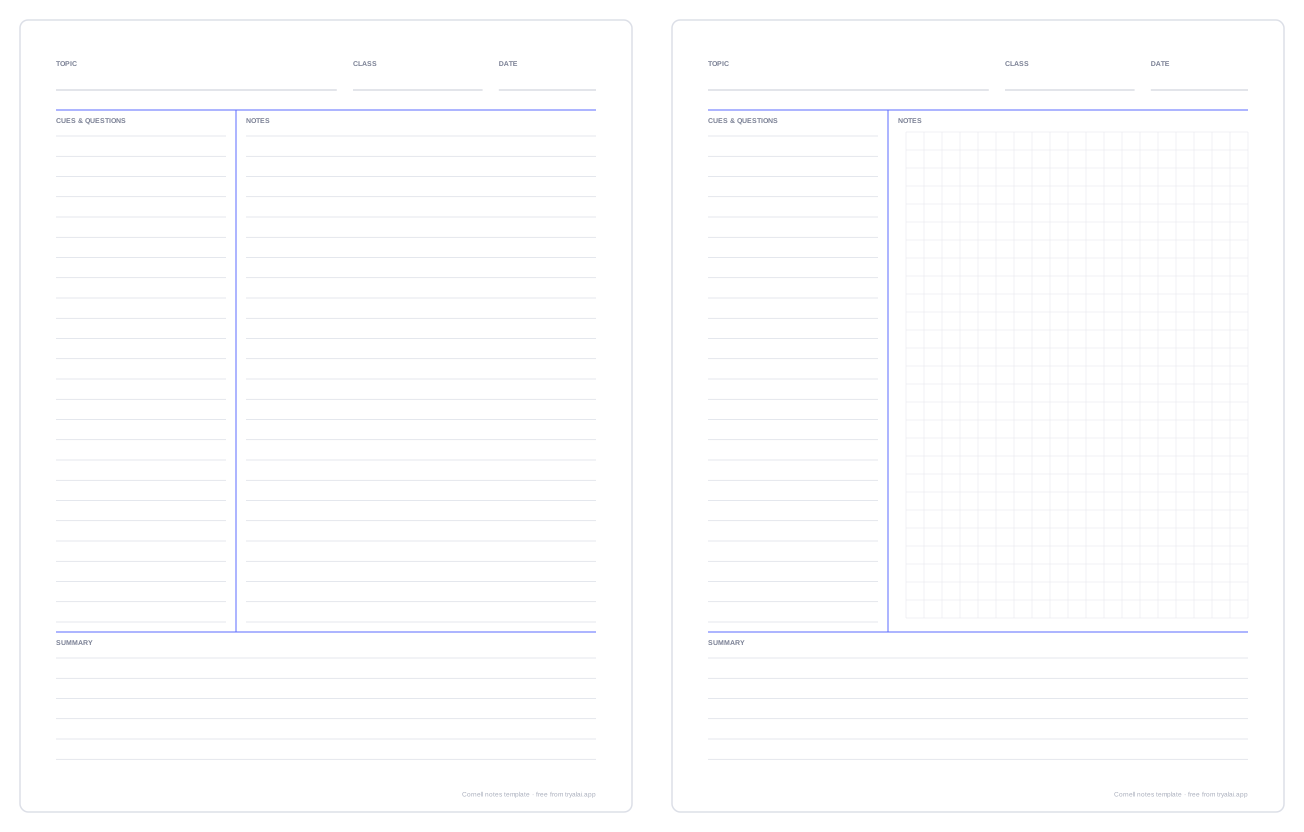
Cornell notes divide each page into a notes column, a narrower cue column on the left and a summary at the bottom. You take notes in class, write questions in the cue column afterward, then cover your notes and answer the questions from memory. The same steps work on Cornell paper on a tablet.
The layout
Cornell's Learning Strategies Center handout, adapted from Walter Pauk's book How to Study in College, divides each page into three parts:
- The note-taking column, 6 inches wide on the right, for notes during class.
- The cue column, 2½ inches wide on the left, for questions and key words you add after class.
- The summary, a 2-inch strip across the bottom, where you sum up the page after class.
Your notes and your questions sit side by side, so you can hide one and test yourself with the other. The University of Cincinnati's Learning Commons also suggests writing your name, the course, the date and the lecture topic at the top of each page.
Free Cornell notes templates
We made six free Cornell pages to print or to bring into any notes app that imports PDFs. Each has the topic, class and date at the top, a cue column on the left, a notes area and a summary across the bottom. The Letter pages follow the handout's measurements, with a 2½-inch cue column and a 2-inch summary. The grid pages keep the cue column lined for words and put a grid in the notes area for math and science.
| Page size | Lined | Grid for math and science |
|---|---|---|
| US Letter | Letter, lined (PDF) | Letter, grid (PDF) |
| A4 | A4, lined (PDF) | A4, grid (PDF) |
| iPad and tablets (3:4) | Tablet, lined (PDF) | Tablet, grid (PDF) |
They're free to print, copy and share with a class. The tablet pages are 3:4, the shape of an iPad screen held upright, so a page fills the screen in a notes app.
Where the method comes from
Walter Pauk, who directed Cornell University's Reading and Study Skills Center, created the system in the 1950s. Cornell's memorial statement for Pauk says the first version is thought to date from his time as a teaching assistant, when students' test scores frustrated him, and that he set the method out in How to Study in College, first published in 1962. Later editions were written with Ross J. Q. Owens, and Cornell's Learning Strategies Center still teaches the method.
The five steps
Study guides often call the steps the 5 Rs. Cornell's handout lists the same five, with the second one named Questions:
- Record. During class, write the main ideas and facts in the note-taking column. Short, telegraphic sentences are enough.
- Reduce. As soon after class as you can, write questions or cue words in the left column, each one beside the notes it covers. Writing the questions shows you how the ideas connect and sets up your studying for the exam.
- Recite. Cover the note-taking column. Looking only at the cue column, answer each question out loud in your own words, then uncover the notes to check.
- Reflect. Ask yourself what the facts mean, what principle they rest on, how you'd apply them and how they fit with what you already know.
- Review. Spend at least ten minutes every week going back over all your earlier notes.
The summary at the bottom gets written after class too, in a few sentences of your own.
An example from a physics class
Here is one page of Cornell notes from an introductory physics lecture on Newton's second law. The cue column was filled in after class.
| Cue column | Notes column |
|---|---|
| What does Newton's second law say? | ΣF = ma: the net force on an object equals its mass times its acceleration |
| What is a newton? | The unit of force: 1 N = 1 kg·m/s² |
| How do you find the net force? | Add every force on the object, with its direction. Then a = ΣF ÷ m |
| A 10 N pull and 4 N of friction act on a 2 kg cart. What is its acceleration? | ΣF = 10 N − 4 N = 6 N, so a = 6 N ÷ 2 kg = 3 m/s² in the direction of the pull |
| The forces balance. Is the object at rest? | Not always. ΣF = 0 means a = 0, so the velocity stays the same, and that velocity may or may not be zero |
| How are weight and mass different? | Weight is a force: W = mg, with g ≈ 9.8 m/s² near Earth's surface. Mass, in kg, is the same anywhere |
Summary: The net force on an object, found by adding every force with its direction, equals its mass times its acceleration. With no net force there is no acceleration, so the object keeps whatever velocity it has. Weight is the force of gravity, W = mg, while mass doesn't change from place to place.
To recite from this page, cover the right column and work through the cues. In a STEM class, a cue can be a short problem like the cart one, so reciting means solving it again on scratch paper before you look.
What studies of Cornell notes found
Studies that test the method directly are small, and their results are mixed:
- In a 2012 study in a high school child development class, one section of 16 students learned Cornell notes and another 16 took notes their own way. Scores on three unit tests didn't differ significantly, and on the last test the averages were 83.06% for the Cornell section and 83.44% for the other. The authors note they couldn't tell whether students used their notes to study.
- A 2016 Rutgers dissertation trained 60 eighth graders in social studies, with and without disabilities, in Cornell note-taking and review, and called the results inconclusive.
- In a 2008 classroom study, two sophomore English classes of 29 students learned either guided notes or Cornell notes. On a quiz made mostly of recall questions, the guided-notes class rose from 51% to 84% and the Cornell class from 56% to 61%, though the Cornell students did better on the higher-level questions.
- In a 2023 study of 128 nursing students in Morocco, the group trained in the method took better notes and did better on a quiz than an untrained group, and a 2024 study of 40 first-year university students found more progress in listening comprehension after Cornell training.
Most of these compared existing classes or groups instead of randomly assigning students, so they can't settle whether the format itself helps.
Why the method can still help
Two of the five steps match techniques with strong evidence. Reciting from the cue column is practice testing, one of only two techniques rated high utility in a 2013 review by Dunlosky and colleagues. In Roediger and Karpicke's 2006 experiment, students who recalled a passage three times remembered 61% of its ideas a week later, against 40% for students who only read it. The weekly review spreads practice out over time, the other high-utility technique, and a 2006 synthesis of spacing research found that the best gap between sessions grows the longer you need to remember.
The summary has weaker support. Dunlosky's team rated summarization low, since its benefits showed up only for some students on some tests. Writing one is still a quick check on whether you followed the lecture.
So the format on its own gives you tidy notes. Most of the evidence is behind the parts that take effort later: covering the notes, answering the cues, and doing it again in the weeks that follow.
Cornell notes on an iPad or tablet
The method works the same on a tablet:
- Use Cornell paper. Many note apps include it. Goodnotes comes with a Cornell template, and its blog links a free printable one. Evernote has a Cornell Notes template too.
- Record with your pencil in the wide column during class, and add the cues and summary the same day.
- Cover the notes column to recite. Use your app's tape or cover tool if it has one, or a sheet of paper, then answer each cue out loud before you look.
- Put the weekly review on your calendar so the Review step happens.
In alai
alai is a note-taking app for iPad and the web with Ally, an adaptive AI tutor that teaches alongside you. We make alai, so keep that in mind as you read this part.
- Cornell paper on every plan, including Free, with the cue column down the left and the summary across the bottom.
- Tape for the Recite step. Lay a strip of tape over each line or answer in the notes column, read the cue, answer, then tap the tape to peek. A note always opens with its tape covering again, so next week's review starts fresh.
- Record class. Record the lecture as you write, then tap your notes to hear that moment. The audio stays on your device, and Free records 20 minutes per note.
- Flashcards and quizzes on Pro. alai can turn a note into flashcards or a quiz. You answer quiz questions by hand and Ally checks them, and flashcard review brings cards back when they're due, which spaces your review for you.
The guide to AI note taking covers what the AI study tools do and what research says about them, and pricing lists what each plan includes.
Questions
Is there a free Cornell notes template?
Yes. This page has six free Cornell notes PDFs, lined and grid, in US Letter, A4 and a 3:4 size for iPads and tablets. Print them, or import them into any notes app that takes PDFs.
What are the 5 Rs of Cornell notes?
Record, Reduce, Recite, Reflect and Review. You record notes in class, reduce them to questions in the cue column, recite the answers with the notes covered, reflect on what the ideas mean, and review all your notes each week.
How wide is the cue column in Cornell notes?
Cornell's Learning Strategies Center handout gives 2½ inches for the cue column, 6 inches for the notes and a 2-inch summary across the bottom. On a tablet, any Cornell paper with a narrower left column works the same way.
Do Cornell notes work for math and science?
The format suits them. Put definitions, formulas and worked examples in the notes column and short problems in the cue column, so reciting means solving them again. None of the Cornell studies on this page was run in a math or physics class, though, so the direct evidence for STEM is thin.
Is there a Cornell notes template for iPad?
Yes, several note apps include one. Goodnotes comes with a Cornell template, and alai has Cornell paper on every plan, including Free.
Are Cornell notes better than other note-taking methods?
Studies of the method itself are small and mixed. Its strongest parts are the ones backed by broader research: testing yourself from the cue column and reviewing on a schedule.
Sources
- The Cornell Note-taking System (handout adapted from How to Study in College, 7th edition, by Walter Pauk)Cornell University Learning Strategies Center · accessed November 5, 2026
- The Cornell Note Taking SystemCornell University Learning Strategies Center · accessed November 5, 2026
- Walter Pauk, May 1, 1914 to December 7, 2019 (memorial statement)Cornell University, Office of the Dean of the University Faculty · accessed November 5, 2026
- The Cornell Method for Note-TakingUniversity of Cincinnati Learning Commons · accessed November 5, 2026
- Quintus et al., The impact of the Cornell note-taking method on students' performance in a high school family and consumer sciences classJournal of Family & Consumer Sciences Education, 30(1), Spring/Summer 2012
- Baharev, The effects of Cornell note-taking and review strategies on recall and comprehension of lecture content for middle school students with and without disabilities (Ed.D. dissertation)Rutgers University, 2016
- Jacobs, A comparison of two note taking methods in a secondary English classroomProceedings of the 4th Annual GRASP Symposium, Wichita State University, 2008
- Amhout et al., The effect of the Cornell method on the quality of grade production and learning performance of nursing studentsPedagogical Research, 8(2) · April 2023
- Abualzain, The effect of implementing Cornell note-taking strategies on new students' performance in listening comprehensionTheory and Practice in Language Studies, 14(8) · August 9, 2024
- Dunlosky et al., Improving students' learning with effective learning techniques: Promising directions from cognitive and educational psychologyPsychological Science in the Public Interest, 14(1) · January 2013
- Roediger and Karpicke, Test-enhanced learning: Taking memory tests improves long-term retentionPsychological Science, 17(3) · March 2006
- Cepeda et al., Distributed practice in verbal recall tasks: A review and quantitative synthesisPsychological Bulletin, 132(3) · May 2006
- Cornell Note Taking: The Best Way To Take Notes, ExplainedGoodnotes Blog · June 3, 2024, accessed November 5, 2026
- Cornell Notes TemplateEvernote · accessed November 5, 2026